

If there’s anything expired, it has to be gotten rid of, but the question remains: how? The FDA has specific guidance on how to get rid of expired or no longer wanted medications and drugs, and it has a lot to do with the Flush List.
Checking the Flush List
The FDA says to consult its website, fda.gov, when searching for guidance on disposing of unused medications, and to check the Flush List. Go to the site, pull up the list, and if the drug being disposed of is on that list, it’s okay to flush it, according to the FDA.
There are a lot more drugs on the Do Not Flush List than the Flush List.
Disposing of Medications Not on the Flush List
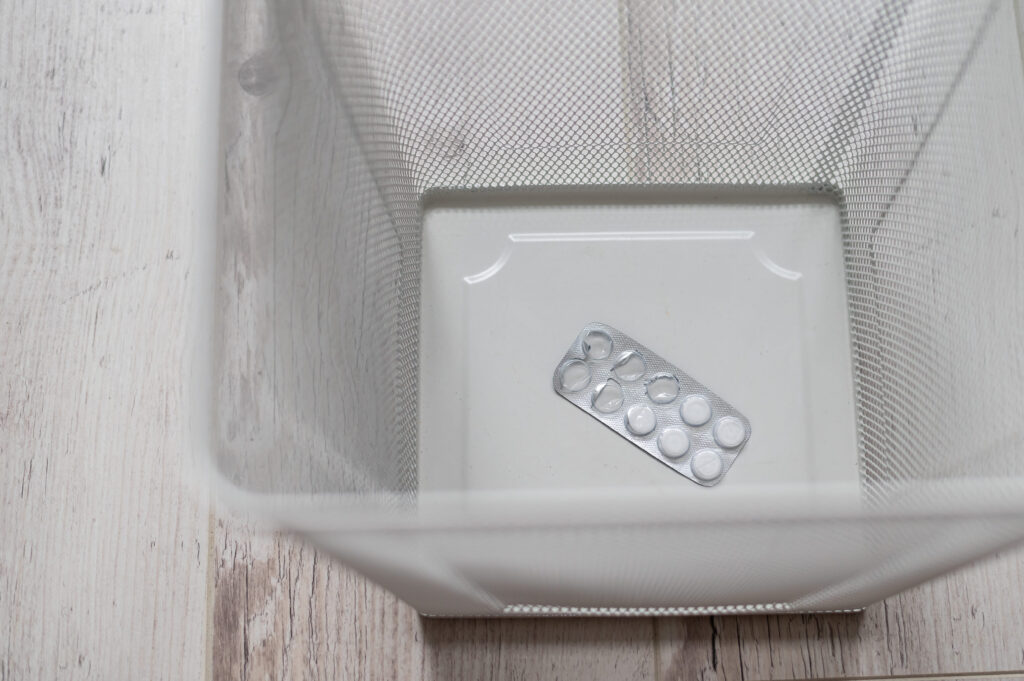
Ways to Dispose of Expired Medication
If a drug is not on the Flush List, the FDA has more specific guidelines. Do not crush the tablets or capsules. Mix them with an unappealing item, and the FDA lists things like dirt, cat litter, or used coffee grounds.
Place the mixture in a container, such as a sealed plastic bag, and throw that container in the trash at home. Take the precaution of removing any personal information before throwing away the empty vial or its packaging.
Checking the Flush List should happen often before disposing, since the list and guidelines do change. This can be done a couple of times a year, maybe twice, three, or four times a year. Looking at what’s in a medicine cabinet, if something is going to expire before the next purge, it should be gotten rid of then.
Checking Local Municipality Guidelines
Just because the FDA says something is so doesn’t necessarily mean the local municipality agrees with that advice. Local municipalities are responsible for maintaining water supply and trash collection or landfills in the area, so whatever the FDA guidance is on a topic or drug should be checked against what the local municipality offers.
Guidelines for consumers in their homes may differ from guidelines for larger amounts of medication kept in an office setting, so checking with the local municipality helps confirm what applies for a given area.
Local Drop Box Resources
A number of resources are available for disposing of expired medications or those no longer needed on hand. The majority of police departments have drop boxes where expired medications can be dropped off. A lot of pharmacies also have drop box locations these days. To find the closest drop box location, visit doseofreality.gov, where you can enter a zip code to find nearby drop boxes.
Disposing of Controlled Substances
The majority of drop box locations can accept controlled substances. The DEA has authorized pharmacies, doctors’ offices, and police stations to take back controlled substances, so drop boxes and retail pharmacies can do so, and the majority of police stations can as well.
Disposing of Needles and Sharps
The most important thing, even when using needles at home, is to store them in a hard plastic container. Ideally, an actual sharps disposal container should be used, which can be found at almost any pharmacy relatively cheaply.
If access to one isn’t available and needles need to be disposed of, an empty laundry detergent container is a great place to throw them. Once they are in hard plastic containers, some police departments take them back, and some retail pharmacies can take those needles and other sharps back, provided they’re in that hard plastic container.
Privacy Protections at Drop Boxes
Most drop boxes go untouched, so no one sees personal information. The DEA has a law in place that says anybody who has a reverse distributor is not allowed to sort or go through it, so items should be able to be dropped off directly into the drop box container.
To protect privacy further, names or other identifying information can be crossed out before tossing. Otherwise, retail pharmacy boxes go directly to an incinerator, so no one sees any information inside.
Drug Take-Back Days
Statewide drug take-back days happen across the state, one in spring and one in fall, where different communities have events where expired medications can be brought back. For more information about upcoming drug take-back dates, visit doseofreality.gov; it lists them there.
Personal Information Protection Beyond Drop Boxes
Another reason to black out all personal information on anything that goes into the trash applies beyond just medication packaging. Soaking labels off and then shredding them is one way to take that precaution a step further, even if some people might think that’s a little over the top.
Taking matters into your own hands, rather than waiting to return items to a local pharmacy, is one way to handle disposal directly, since pharmacists would have a hard time figuring out what to do with all those returned medications.